





Creativity is often described as imagination, inspiration, or artistic expression. In professional fields especially those tied to real-world consequences like tactical operations, engineering, or business creativity is something far more practical. It is the disciplined art of making the possible real.
You start with a vision > You have the initiative to try > Now comes the hard part.
The Foundations of Practical Creativity.
Real creativity is not spontaneous. It is built on layers of competence and understanding. Before a solution can exist, certain conditions must be met.
You must have:
• Knowledge of the subject.
• Experience to understand its practical or tactical application.
• A clear understanding of the problem set.
• The technical ability to create a solution.
• The mental flexibility to see that solution before it exists.
• A defined and realistic end state.
Creativity is not just about inventing something new. It is about answering the right question.
Sometimes that question hasn’t even been asked yet.
Are You Solving the Right Problem?
Before building anything, you must understand the nature of the problem itself.
• Are you answering a question no one has recognized yet?
• Are you solving a clearly identified problem?
• Is the problem singular, or is it multi-layered?
• If you solve one part, will the rest fall into place?
• Or is each layer its own independent requirement?
Many failed designs are not failures of execution—they are failures of problem definition.
From Concept to Reality
Once the problem is understood, creativity shifts from abstract thinking to applied execution.
You must consider:
• Is the solution efficient?
• Can it be produced at scale, or only as a one-off?
• Does it actually improve the system, or just look different?
In tactical equipment design, creativity is not measured by novelty. It is measured by effectiveness.
A new concept must:
• Improve function
• Reduce complexity
• Increase survivability or efficiency
• Be producible and supportable in the real world
Otherwise, it is just an experiment or as some say it’s just a hobby.
Rethinking the Paradigm: Symmetry and Function
One example of practical creativity is the concept of load carriage symmetry.
Ergonomic symmetry exists when a task or tool allows the body to operate in a balanced, neutral, and repeatable manner—without forcing one side to compensate for the other.
In equipment design, this often translates to:
• Three to four rifle magazine pouches centered on the torso
• Pistol magazines placed for rapid access
• Grenades, flashbangs, and mission items distributed evenly
• Ambidextrous access to critical equipment
This configuration promotes balance, consistency, and repeatable performance across a team. But symmetry is not always the answer. During special tasks or mission-specific operations, the real question becomes: Is visual or load symmetry more important than immediate access to the correct tool at the exact moment it is needed? In many cases, the answer is no. Creativity means knowing when to follow the paradigm and when to break it.
Understanding the business side of creativity is just as important as the technical side.
A great idea must:
• Reach the market
• Be produced reliably
• Be supported long-term
• Compete against other solutions
Creativity without execution is just theory
Case Study: The Mayflower UW Chest Rig Evolution
One example of creativity as an iterative, problem-solving process is the development of the Mayflower UW (Unconventional Warfare) chest rig series. These designs were not the result of a single flash of inspiration. They were the result of years of operational experience, observation, and incremental improvement.
Each generation solved a specific problem. I took the lessons learned from my designs for the DBT Low-Vis Chest Rigs and operationally improved them:
UW Gen I – The Baseline Concept, breaking the paradigm:
The Gen I represented a shift away from traditional load carriage systems that were either:
too minimal (CHICOM Chest Rig) or too complex (full vest systems replacing belt kit). The goal was simple: carry the essential fighting load in a compact, balanced, low-profile format.
The Gen I focused on: centerline rifle magazine carriage, integrated general-purpose storage, only what you need. A balanced, symmetrical layout, dual comms, ambidextrous and low bulk for vehicle and urban operations.
It established the core concept: self-contained, multi-missionfighting load in a simple chest-mounted platform.
UW Gen II & GEN II.V Refinement Through Use
The Gen II was not a radical redesign. It was a refinement.

Changes were driven by real-world feedback. Long-term wearand practical adjustments from field use.
Key improvements included: H-Harness refinements, initially fixed but still range of motion/size adjustable then a quick don/doff capability was added.
The lesson from the Gen II was simple: small, thoughtful changes often produce the biggest performance gains.
 UW GEN I “Custom” that led to future development (as it was worn in combat).
UW Gen III — The Standardization Phase

By the time the Gen III emerged, the concept had matured.
This generation focused on: refined magazine retention, a cleaner manufacturing processes, and a format suitable for broader adoption across units
The Gen III represented the transition from:
“a good idea” to “a scalable, supportable piece of equipment.” This is a critical step in creativity:
A solution is not complete until it can be produced, issued, and sustained.
UW Gen IV — Modularity and Integration
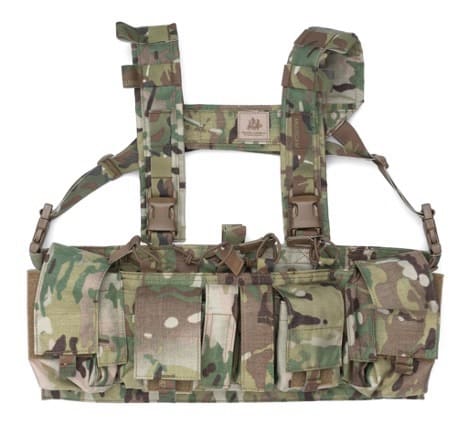
The Gen IV reflected changing operational realities.
Users increasingly needed, integration with armor, greater modularity, and compatibility with multiple mission sets
The Gen IV addressed this byimproving attachment options, increasing compatibility with plate carriers and allowing mission-specific add-ons
This generation acknowledged a key truth: The environment changes. The equipment must evolve with it.
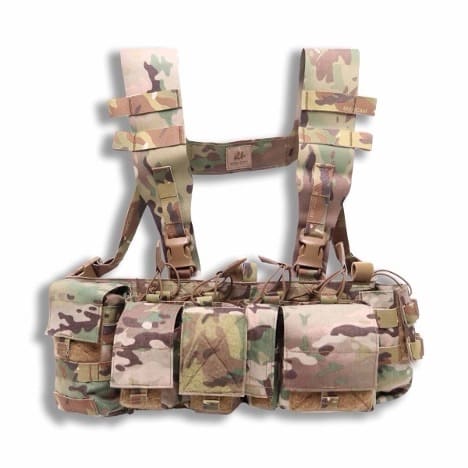
 UW Gen V — The next step
By the time the Gen V arrived, the original concept had been fielded in the tens of thousands.
This design focused on splitting the base in half to meet a different operational need (an open front), streamlined construction, matching H-Harnesses, similar construction techniques, optimized pouch geometry to meet operational requirements, magazine inserts for different calibers, improved materials and manufacturing methods. Abalance between modularity and simplicity.
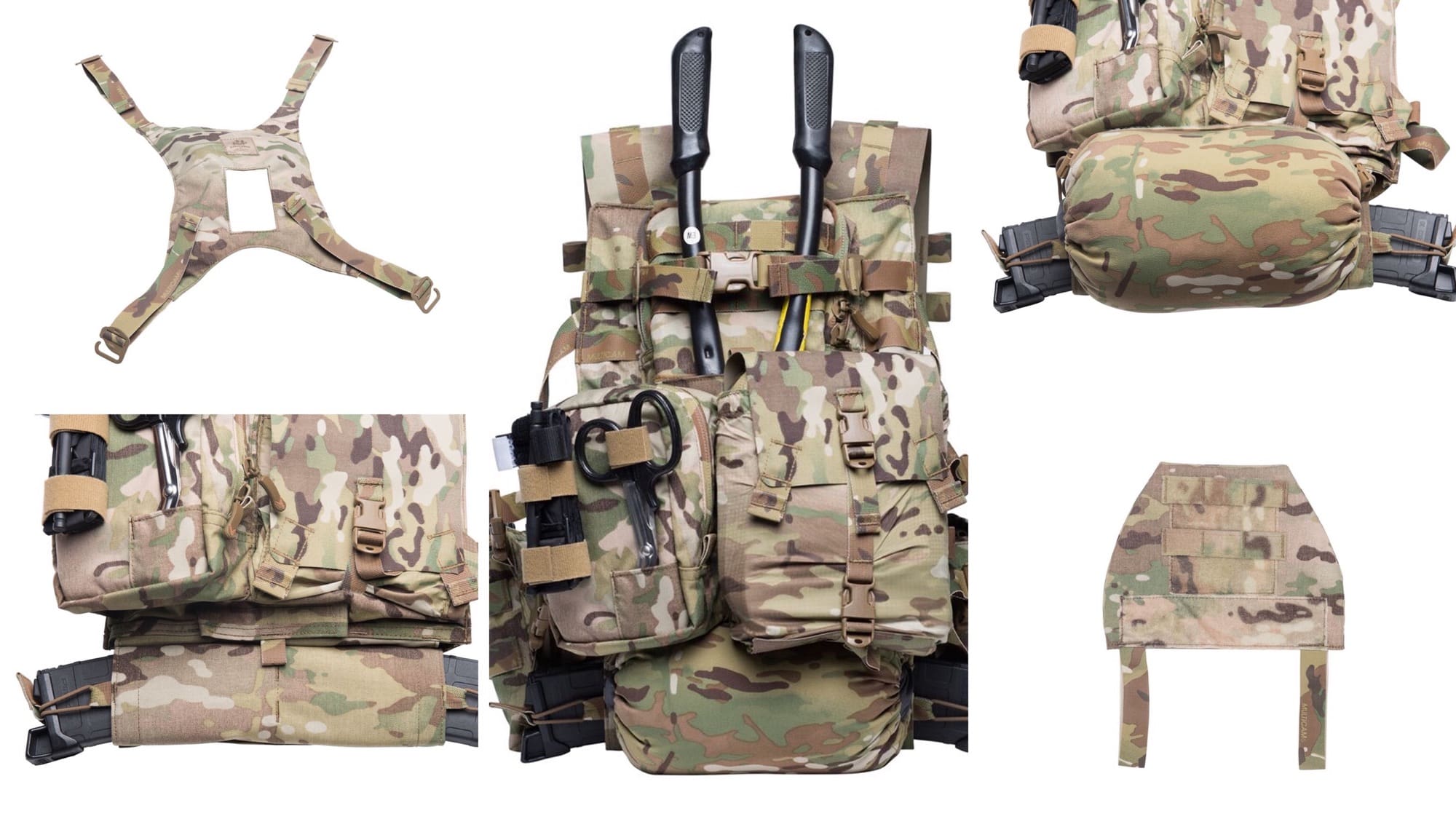
 UW Gen VI “Pusher” — The Mature Concept
The “Pusher” chest rig represented the evolutionary development of the UW series—a single platform, multi-caliber capable, and configurable for use with or without armor. It was built as a plug-and-play system, allowing magazine pouches to be mounted on the lower back for prone use, the addition of a cold-weather jacket pouch, and the ability to carry a NODS-mounted helmet as required.
Lessons from the UW Series.
The evolution from Gen I to Gen VI demonstrates several key principles of practical creativity:
• Creativity is iterative; no design is perfect at the start. Each generation solves a problem the previous one exposed.
• Experience drives innovation; most improvements were not theoretical. They came from actual use, under real conditions.
• Simplicity is the end state, as a concept matures, unnecessary complexity is stripped away.
• Production matters; a design is only successful if it can be produced in quantity and supported over time.
The Business Reality of Creativity
Creative success brings its own set of challenges.
After achieving even moderate success, many designers and entrepreneurs experience a predictable cycle:
• Imposter syndrome: was this a one off or have I spent my creativity?
• Learning to deal with success
• Reconciling unconventional paths to achievement, no college degree versus experience
• Pressure to recreate the successful formula
• Pushing through self-doubt
• Selling your own strengths while trying to remain humble
• Regaining the drive to outperform competitors
The Next Chapter
At some point, you begin to recognize where your real strengths lie. Not just what you can create, but:
• What problems you are best suited to solve
• What environments you perform best in
• What kind of impact you want to have
That realization marks the transition into the next chapter. You stop trying to prove yourself = You start building with intent. Creativity, at its core, is not about originality for its own sake. It is about:
• Understanding the problem
• Seeing a path forward
• Having the skill and discipline to make it real
That is the true Art of the possible.
About the author: Travis Rolph is a retired Airborne Infantry and Special Forces veteran and founder of Mayflower Research & Consulting.
Read the full article here
