




Ready or Carry? The Question That Drives the Pistol Flow Drill
Every pistol position starts with one question: can I use the gun right now?
By John Chapman, Task Force 70 Foundation
Watch people work a shoot house with a pistol and most of them spend the whole run in low ready. Gun out, muzzle somewhere south, swinging through every room and every teammate.
Low ready is the most-used pistol position I see. It also causes the most problems, for safety and for speed.
The Pistol Flow Drill exists to fix that. Chris Sizelove, my partner on the Forge Tactical methodology, lays it out in this Blue Force Gear video,?“PISTOL FLOW DRILL: Ready Positions, Carry Positions, and Armed Movement.”
The drill works through every position a pistol can be in, defined in plain words, with the rules of firearm safety built into each one.
Standard words matter. If a team isn’t using the same terms, you don’t get a discussion. You get an argument.
The whole drill hangs on one question:
Can I use the gun right now, safely and efficiently?
That means nobody’s in front of you, you’re online with your partner, and anything you can’t point a gun at is accounted for. If the answer is yes, you’re in a ready position. If the answer is no, you’re in a carry.
The position should change when the environment changes.
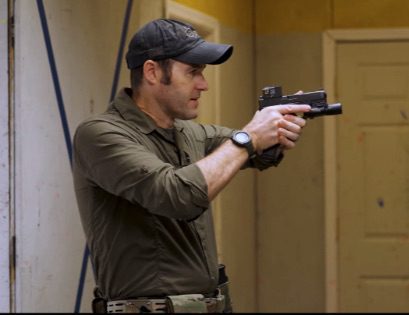
Four Ready Positions
High ready
Both hands on the gun, barrel angled up 35 to 45 degrees, roughly above the heads of anyone in front of you. You can still run your light and bloom the ceiling.
If you’re staring at the back of your slide, it’s too high. Get it out of your face and look over it. Barrel angle is what counts.
Compressed ready
Barrel parallel to the deck, gun pulled in and out of your line of sight. Your light works, and you can punch straight out to the target.
Retention
Pistol held high and tight so your support hand is free for a door knob or anything else. Keep that hand clear of the muzzle, and don’t bend at the waist. Change your height with your legs.
Low ready
Barrel at the baseboards. Use it when what you’re orienting on is low, or when something keeps you from pointing up. That’s about the only time Chris uses it.
Note the word is?oriented, not aimed.
Aiming at an empty doorway buys you almost nothing. You see less of it, and if someone steps out who doesn’t need to be shot, your gun is already on them. That’s how unknowns and no-shoots get hit.
Two carry positions
If you can’t use the gun, all you’re doing is carrying it safely to a spot where you can.
Low carry
Muzzle straight down between your feet, gun indexed against your body. Use it when you can’t point up: a catwalk overhead or the bottom floor of a multi-story entry.
If you’re wearing a plate carrier, push the gun out past your kit, point it straight down and index it. A pistol held out at an angle will flag people when you pivot.
High carry
Gun indexed at your head, with the joint of your thumb set in the notch by your ear. Use it when you can’t point down because people are on the floor, a teammate is kneeling, or you’re upstairs with friendlies below.
In both carries, the gun is touching your body. If you trip or get bumped, you still have control of it.
The holster is the third option
If you don’t need the gun out, leave it holstered with your hand on it and the retention defeated.
Chris has no use for holster index or behind-the-leg carries. If you need both hands, those positions force you to reholsterunder stress, which is one of the most dangerous things you can do with a pistol.
If it goes to guns, you’ve drawn from the holster more times than you can count. Use that.
Armed movement
Positions are skills.?The point is to link them.
Any time you turn outside your field of view with a gun in your hand, rifle or pistol, do these four steps in order:
1. Come to a carry.
2. Pivot and look.
3. Decide where to go, then go there, all the way online with your partner.
4. Come to a ready position, or on target.
Skip step three and you end up pointing your gun in your partner’s direction. If he steps off the X or trips, your gun is out of the fight.
Sport shooters drag the gun and their eyes across targets because it’s faster on a range.?That doesn’t translate to a hallway filled with teammates, unknowns, or people who don’t need a gun pointed at them.
Pick one position you use by habit and ask whether it answers the question:
Can you use the gun from there?
If you can’t, you should be in a carry.
The Pistol Flow Drill isn’t about memorizing six positions.?It’s about recognizing when the environment changes and moving to the position that lets you safely solve the next problem.
Watch Chris Sizelove demonstrate the complete Pistol Flow Drill and see how the positions connect during movement.
Disclaimer: This article is provided for general educational and informational purposes only and reflects the views of its author and the methodology described. It is not a substitute for qualified, hands-on instruction. Firearms handling and tactical movement carry inherent risks. Always follow the four rules of firearm safety, applicable laws, and your agency or organization’s policies and training. Task Force 70 Foundation and its contributors assume no liability for any injury, loss, or damage resulting from the use or misuse of this information.
Read the full article here
