





GRAFENWOEHR, Germany — The senior enlisted advisor for Joint Interagency Task Force 401, Sgt. Maj. Kellen Rowley recently visited Germany to serve as the graduation speaker for the Joint Multidomain Counter-Unmanned Aerial Systems Course, or JMDCC.
The course, a U.S. Air Forces in Europe program executed with the support of the 7th Army Training Command, is at the forefront of developing joint service capabilities to counter the growing threat of unmanned aerial systems. This effort supports JIATF-401’s mission to provide counter-drone capabilities that protect U.S. personnel and facilities both domestically and internationally through a whole-of-government approach.
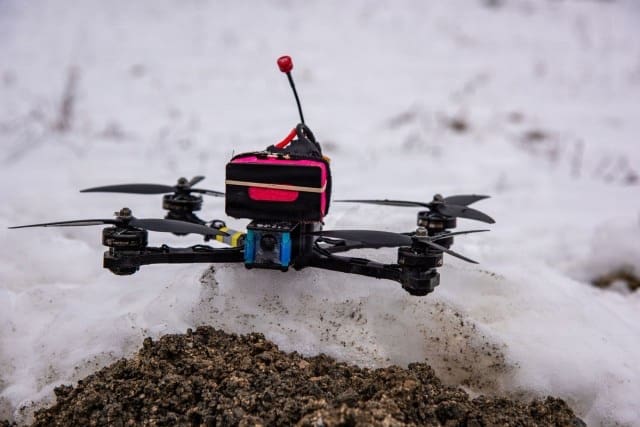
During his visit, Rowley observed the course’s culminating field training exercise, a rigorous 48-hour event that tested the skills of 22 U.S. Air Force, Army and Marine noncommissioned and commissioned officers. He also received a comprehensive overview of the course’s program of instruction and engaged with the 7th ATC leadership, which included a briefing on the Bumblebee training course, Test and Evaluation Center and the Warrior Unmanned Aerial Battalion.
In his remarks to the graduating class, Rowley emphasized the importance of taking proactive C-UAS measures at all echelons.
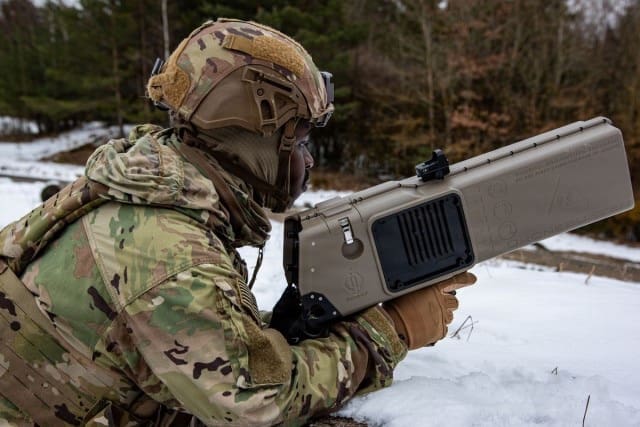
“The proliferation of UAS technology on the modern battlefield requires us to be agile and adaptive,” said Rowley. “We must ask ourselves: what are we doing to establish and rehearse our battle drills and SOPs at the small unit level? How are we integrating C-UAS into our collective training? The answers lie in the hands of talented and dedicated individuals like you… A vigilant and prepared force is the first and most effective line of defense.”
Highlighting the need for specialized skills, Rowley added, “We must actively identify talent within our ranks — the service members who possess the knowledge, capability, and desire to excel in this rapidly evolving space. They are the future of our C-UAS enterprise.”
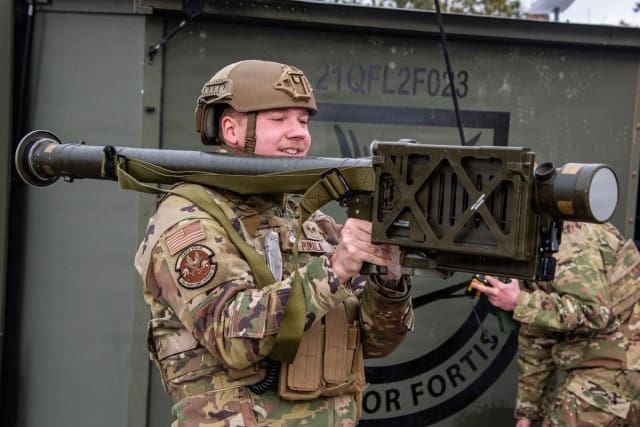
Rowley noted the JMDCC’s platform-agnostic approach and focus on core competencies such as electronic warfare, sensor integration, and command and control. The three-week course is structured to provide a comprehensive learning experience, with one week of classroom theory, one week of practical exercises, and one week of lane training, culminating in the final FTX.
“The JMDCC is an excellent course that has intuitively set the standard for the train-the-trainer model we need across the force,” said SGM Rowley. “To my knowledge, there is no other C-UAS course in the department operating at this level of proficiency and realism.”
U.S. Soldiers, Airmen, Marines and Belgium Soldiers conduct weapons qualifications using the SMASH 2000 system during the Air Force’s Joint Multi-Domain Counter Unmanned Aircraft Systems Operator Course in the Grafenwoehr Training Area, Germany, Feb. 12, 2026. The U.S. Air Forces in Europe – Air Forces Africa assess the feasibility of expanding the Air Force’s Joint Multi-Domain Counter Unmanned Aircraft Systems Operator Course to a multi-service environment with the growing Unmanned Aircraft Systems threat. The 7th Army Training Command remains the premier location for U.S., NATO and partner testing, experimentation, readiness and interoperability. U.S. Army video by Sgt. Collin Mackall.
Story by COL Adam Scher
Read the full article here
